How the civics portion works
The civics test happens out loud. During your naturalization interview a USCIS officer works through questions
from the official list one at a time and you answer in English. There is no multiple choice and nothing to write
down.
On the 2025 version the officer draws from the list of
128 civics questions and answers and asks up to 20. You pass
by answering 12 correctly. The officer also stops early once the result is settled, so at 12
correct you have passed, and at 9 incorrect you can no longer get there.
The questions come from three subject areas. American government covers founding principles, how the system is
set up, and the rights and responsibilities of citizens. American history runs from the colonial period and
independence through the 1800s and into recent history. Symbols and holidays covers the flag, the anthem, and
national holidays.
A few answers depend on where you live or change with elections: your state's senators and representative, your
governor, and whoever currently holds office in Washington. Check those close to your interview date instead of
memorizing them early.
The same appointment includes the English test and the officer's
questions about your N-400. For the whole sitting, read
our guide to the naturalization interview.
What changed from the 2008 test, and what did not
The list grew from 100 questions to 128, the officer asks up to 20 instead of
10, and passing takes 12 correct instead of 6. The pass rate stays at 60 percent either way;
there is simply more to hold in memory.
The 2008 geography section did not carry over. Oceans, rivers, and which states border Canada or Mexico are 2008
questions; the 2025 list keeps only a few place facts, like the national capital and where the Statue of Liberty
is. The change also stops at the civics portion: the English reading, writing, and speaking test runs the same as
before.
Exemptions and special consideration
Two accommodations depend on your age and how long you have held a green card, both measured as of your filing
date.
The 65/20 special consideration shortens the list itself. At 65 or older with 20 or more years as
a lawful permanent resident, you study 20 designated questions, marked with an asterisk in the
official 2025 materials. The officer asks 10 of them and you pass with 6 correct. The 2008 test has the same
accommodation.
The 50/20 and 55/15 rules work on the language side. If you are 50 or older with
20 years as a resident, or 55 or older with 15 years, you can take the civics test in your own language with an
interpreter and skip the English reading and writing test. The civics test itself still applies.
Read more about the 65/20 special consideration
How to study 128 questions
Volume is the real work here. Going category by category helps, because related questions
reinforce each other and you can tell when a whole topic has landed. Keep the sessions
short and frequent too. The officer is testing what you still remember weeks or months
after you started, so spacing the work out does more for you than how much you get through
in one sitting.
Once you can get through most of a category from memory, switch to practice tests in
the real format. Recognizing an answer on a flashcard is a long way from saying it out loud to a stranger, and
closing that distance is what the mock interview is for.
Free in the app
- All 128 questions as flashcards grouped by category, with mastery tracking so you can see which topics are solid.
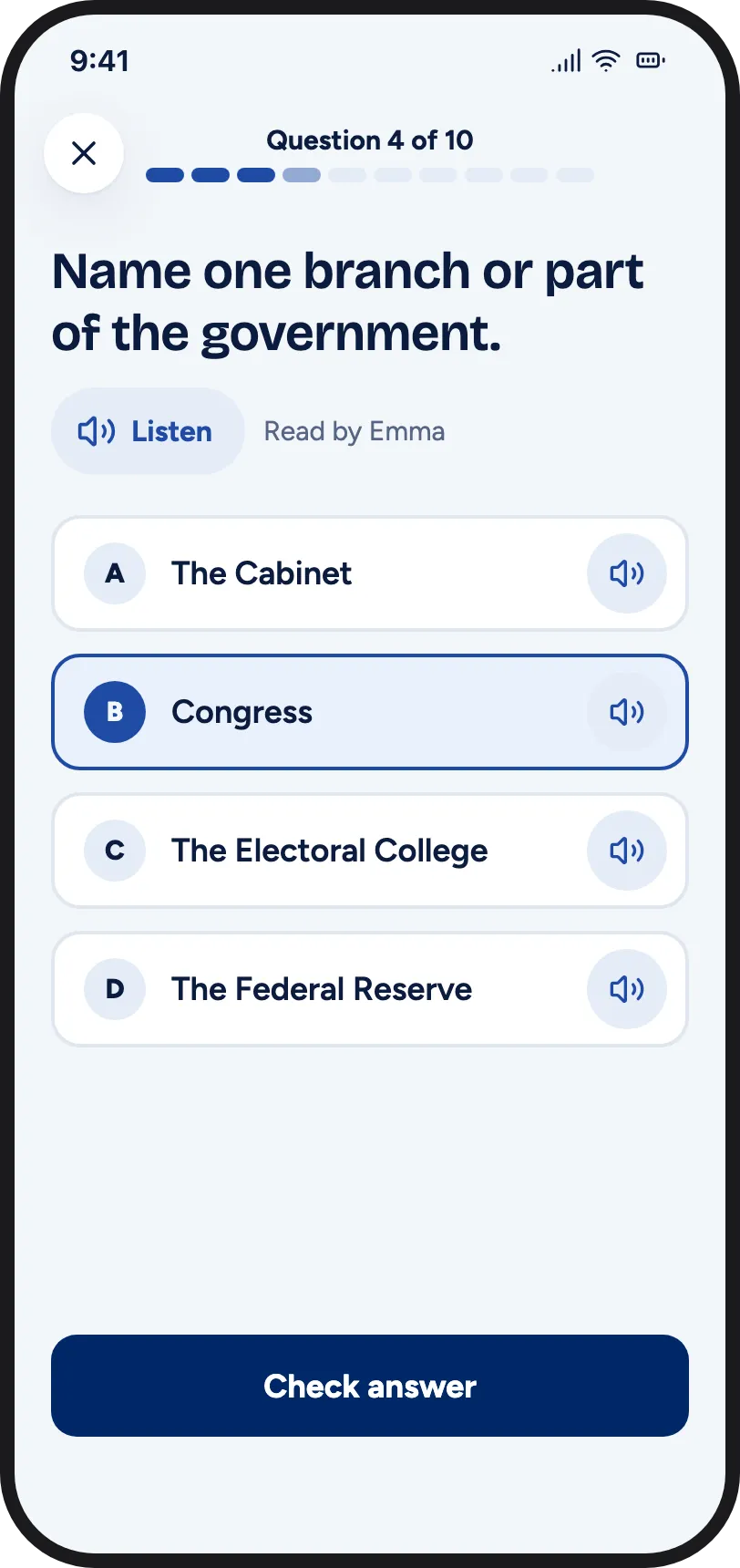
- Unlimited practice tests, in the self-check format the officer actually uses and in multiple choice.
- Every question and answer read aloud, if you would rather listen than read.
Pro adds the full mock interview, where a spoken officer takes you through the whole N-400 from
the oath to the civics questions, and a study plan that counts down to your interview date, keeps pushing the
questions you miss back in front of you, and puts a readiness score on where you have got to. It is a
one-time $14.99, never a subscription.
Browse all 128 questions on the 2025 list